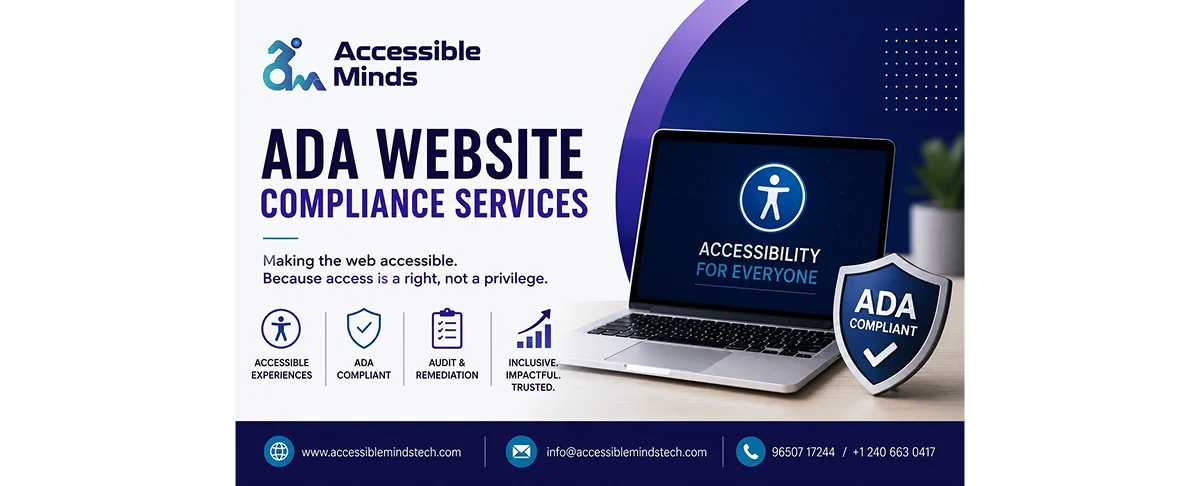

ADA Website Compliance Services: Building Accessible, Inclusive, and Compliant Digital Experiences
Access for all is no longer merely a design aspiration, it is a fundamental component of responsible digital business.
A website is often the first point of interaction between an organisation and its customers, employees, partners, and stakeholders. When digital experiences are inaccessible, people with disabilities can encounter unnecessary barriers while navigating pages, completing forms, purchasing products, accessing information, or interacting with essential services.
ADA Compliance for Websites brings accessibility into the architecture of the digital experience, helping organisations create websites that are more usable, inclusive, and aligned with recognised accessibility standards.
For organisations seeking structured, enterprise-ready solutions, Accessible Minds provides specialised ADA Website Compliance Services designed to identify accessibility barriers, remediate technical issues, and establish a more sustainable accessibility framework.
Accessibility is not an additional feature of a digital experience. It is the foundation of an experience designed for everyone.
What Is ADA Website Compliance?
ADA website compliance refers to making digital content and functionality accessible to people with disabilities in alignment with applicable requirements under the Americans with Disabilities Act (ADA) and recognised accessibility standards.
For state and local governments, the U.S. Department of Justice has established WCAG 2.1 Level AA as the technical standard under its Title II web and mobile accessibility rule. The DOJ’s 2026 interim final rule extended the compliance dates to April 26, 2027, for covered public entities with populations of 50,000 or more, and April 26, 2028, for smaller public entities and special district governments.
While ADA obligations can vary according to the organisation, sector, and circumstances, adopting a robust accessibility methodology can significantly strengthen digital inclusion and reduce avoidable accessibility barriers.
Why ADA Compliance for Websites Matters
Digital accessibility extends far beyond legal considerations. It directly influences usability, customer experience, brand credibility, and the ability of organisations to serve a broader audience.
A strategically accessible website can help users with visual, auditory, cognitive, neurological, and motor disabilities interact with digital content more independently.
Key benefits include:
- Improved digital inclusion across diverse user groups
- Enhanced usability for people navigating with keyboards, screen readers, magnification tools, and other assistive technologies
- Stronger customer experience across devices and interaction methods
- Reduced accessibility barriers within critical user journeys
- Better alignment with WCAG accessibility principles
- More resilient digital experiences as websites evolve and content changes
- Greater organisational awareness of inclusive digital design
What Do ADA Website Compliance Services Include?
Professional accessibility remediation should not be reduced to running an automated scanner and correcting a list of technical warnings.
A mature accessibility programme combines automated testing, manual assessment, assistive-technology testing, remediation, validation, and continuous monitoring.
Accessible Minds can structure an accessibility engagement around key areas such as:
- Accessibility audits and technical assessments
- WCAG-oriented website evaluation
- Keyboard accessibility testing
- Screen-reader compatibility assessment
- Navigation and focus-order analysis
- Colour contrast and visual accessibility review
- Alternative-text and semantic-structure assessment
- Accessible forms, buttons, menus, and interactive components
- Heading hierarchy and content structure analysis
- Multimedia accessibility considerations
- PDF and digital-document accessibility assessment
- Accessibility remediation recommendations
- Post-remediation validation
- Ongoing accessibility monitoring and maintenance
The Difference Between Accessibility Testing and Accessibility Remediation
Testing identifies the barriers. Remediation removes them.
An accessibility audit can reveal issues such as missing alternative text, inadequate colour contrast, inaccessible form controls, improper heading structures, keyboard traps, missing labels, or interactive components that cannot be effectively operated using assistive technologies.
However, identifying an issue is only the beginning.
ADA Website Compliance Services should translate audit findings into actionable remediation. This means prioritising issues according to severity, user impact, business importance, and technical complexity, and then implementing, validating, and documenting the corrective measures.
How Accessible Minds Approaches ADA Compliance for Websites
Accessible Minds takes a structured approach to digital accessibility, helping organisations move from fragmented issue detection toward a more systematic accessibility strategy.
1. Discover
The process begins with an assessment of the website, its templates, components, content types, technologies, and critical user journeys.
2. Assess
Accessibility barriers are evaluated using automated tools alongside manual and technology-assisted testing.
3. Prioritise
Issues are categorised according to their impact and remediation priority, allowing teams to address high-value accessibility barriers efficiently.
4. Remediate
Development and content-level recommendations are implemented to improve accessibility across relevant website components and workflows.
5. Validate
Remediation is followed by regression testing and validation to determine whether identified barriers have been appropriately addressed.
6. Sustain
Accessibility should not end when an audit report is delivered. New pages, features, campaigns, documents, and code releases can introduce new barriers. A sustainable accessibility programme therefore incorporates accessibility into ongoing digital governance.
Compliance is a milestone. Accessibility maturity is a continuous journey.
Why Automated Accessibility Tools Alone Are Not Enough
Automated accessibility tools are valuable for identifying many common technical issues, but they cannot independently determine whether every digital experience is genuinely usable by people with disabilities.
Some accessibility concerns require human judgement and contextual evaluation.
For example:
- Is the content sequence logical?
- Can a keyboard-only user complete the entire transaction?
- Does a screen reader communicate the purpose of an interactive control clearly?
- Are error messages understandable and actionable?
- Does a complex component provide an equivalent accessible experience?
- Can users complete important journeys without unnecessary assistance?
This is why effective ADA Compliance for Websites requires a combination of technology, expertise, manual assessment, and user-centred evaluation.
WCAG and ADA: How Are They Connected?
The ADA is a U.S. civil rights law, while WCAG (Web Content Accessibility Guidelines) is a technical accessibility standard developed by the World Wide Web Consortium (W3C).
WCAG provides measurable success criteria covering areas such as perceivability, operability, understandability, and robustness.
For covered state and local government entities under the DOJ’s Title II web accessibility rule, WCAG 2.1 Level AA is the specified technical standard.
For organisations, the important distinction is that ADA compliance and WCAG conformance are related but not interchangeable concepts. The appropriate accessibility and legal strategy depends on the organisation, its digital services, applicable laws, and regulatory context.
Frequently Asked Questions About ADA Website Compliance
What is ADA website compliance?
ADA website compliance refers broadly to ensuring that a website does not create discriminatory barriers for people with disabilities and that applicable accessibility obligations are addressed. The specific legal requirements can vary depending on the organisation and context.
Is WCAG required for ADA compliance?
WCAG is an important technical accessibility standard. Under the DOJ’s Title II rule, WCAG 2.1 Level AA is specifically required for covered state and local government web content and mobile applications, subject to the rule’s provisions and exceptions.
How do I know if my website has accessibility issues?
A professional accessibility assessment can combine automated scanning with manual testing, keyboard evaluation, screen-reader testing, code-level inspection, and review of important user journeys.
Can an accessibility overlay make a website ADA compliant?
No single accessibility tool or overlay should be treated as a universal substitute for comprehensive accessibility evaluation and remediation. Accessibility needs to be addressed within the underlying website structure, content, code, design, and user experience.
How often should a website be tested for accessibility?
Accessibility should be treated as an ongoing process rather than a one-time audit. Testing should be incorporated into major website updates, redesigns, new feature releases, content workflows, and periodic accessibility reviews.
What are common website accessibility issues?
Common issues include missing or inadequate alternative text, insufficient colour contrast, inaccessible forms, poor heading structures, keyboard-navigation problems, missing labels, inappropriate focus management, inaccessible menus and interactive components, and multimedia without appropriate accessibility support.
Why choose professional ADA Website Compliance Services?
Professional services provide a structured pathway from discovery and assessment through remediation and validation. This can help organisations manage complex websites, prioritise accessibility risks, and establish repeatable processes for maintaining accessibility as their digital ecosystem evolves.
Building a More Accessible Digital Future
A genuinely accessible website is not simply one that passes a technical checklist. It is a digital environment in which people can perceive information, navigate interfaces, understand content, and complete meaningful tasks with greater independence.
For enterprises and organisations operating in increasingly digital environments, accessibility should therefore be embedded into design systems, development workflows, content governance, quality assurance, and product strategy.
Accessible Minds helps organisations transform accessibility from an isolated compliance exercise into a more deliberate digital inclusion and experience strategy.
Summary
ADA Website Compliance Services provide organisations with a structured framework for discovering, addressing, validating, and managing digital accessibility barriers.
From accessibility audits and WCAG-oriented assessments to technical remediation and ongoing monitoring, the objective is clear: build digital experiences that are more accessible, usable, inclusive, and resilient.
With Accessible Minds, organisations can move beyond reactive accessibility fixes and work toward a proactive accessibility culture, where compliance, usability, innovation, and inclusion operate together.
Because the best digital experience is one that leaves no one behind.
Accessible Minds
Website: accessiblemindstech.com
Email: info@accessiblemindstech.com
Phone: 96507 17244 / +1 240 663 0417