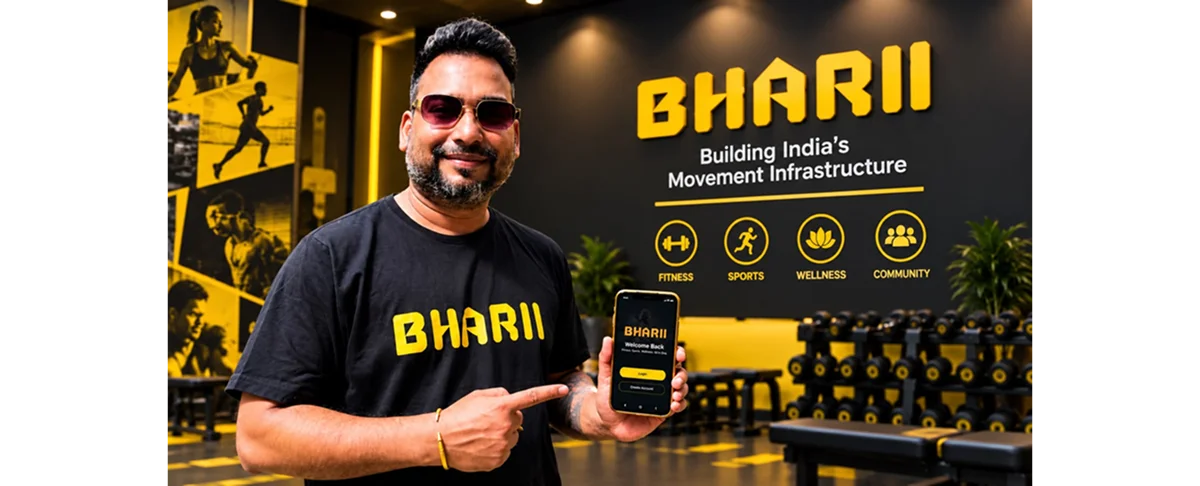

The Bharii Journey of Saugato, a Simple Jamshedpur Boy with a Big Idea
There are some ideas that arrive fully formed, while others take years to become clear. For Saugato Ganguly, BHARII was one of the latter. The idea did not begin in a boardroom, with a business plan spread across a table. It began much earlier, in Jamshedpur, with a young boy who did not yet know what he wanted to build, but knew that one day he wanted to build something meaningful.
Years later, after different cities, different jobs, difficult interviews, conversations with strangers and one particularly memorable encounter with a young karate student, that childhood ambition finally found a direction. Today, Ganguly is building BHARII, a platform that brings together people, fitness centres, trainers and opportunities. But to understand BHARII, it helps to understand the journey that came before it.
When asked where his desire to build something of his own came from, Ganguly goes back to Jamshedpur. “I grew up in a humble family,” he says. There is a small pause before he continues. “And growing up in Jamshedpur, you see the Tata legacy everywhere. You see how a business can become part of the life of an entire city. It creates jobs, supports communities and becomes something much larger than the people who started it.”
Perhaps that stayed with him. As a child, he had no idea that his future would have anything to do with entrepreneurship, fitness or technology. There was no detailed five-year plan, just an instinct that someday he wanted to create something that mattered. He smiles when he remembers those early years. “I didn’t know what I would build,” he says. “I just knew I wanted to build something.”
But before he could build anything, life had other lessons for him. He moved to Vizag for graduation and began his career with one of the world’s leading multinational corporations, working in customer care with sales responsibilities. He stayed there for around four years.
Those years taught him something that no business textbook could quite teach you. He learned how people speak, how they think, what makes them trust someone, what they actually want versus what they initially ask for, and how a conversation can change the outcome of a sale or simply change someone’s experience with a company.
“I think those years were very important for me,” he reflects. “You learn how to deal with different kinds of people. You learn patience. You learn communication. And you understand that behind every transaction, there is a person.”
Eventually, he wanted more. Mumbai seemed like the natural next step, but the move came with its own test. Ganguly went through close to twenty interviews before finally getting an opportunity with a large multinational technology and consulting organisation. He chuckles when the number comes up, almost as though he finds it difficult to believe now. Twenty interviews. Twenty opportunities to hear no before someone finally said yes.
It was not an overnight success story, but perhaps that was the point. The experience taught him persistence before he ever needed the word for it. After around eighteen months, an internal transfer brought him to Kolkata. His responsibilities grew. He worked across projects, managed teams and began seeing organisations from a different angle.
He was no longer looking only at his own role. He was beginning to understand how people, processes and decisions fit together. Still, entrepreneurship remained somewhere in the background.
And then there was fitness. Fitness had always been something Ganguly cared about personally, but eventually, his own experience with gyms began to bother him. The traditional membership model seemed increasingly disconnected from the way people actually lived. Work schedules changed. People travelled. They moved cities. Life became unpredictable. Yet the membership continued, and the money was often spent whether the gym was used or not.
He pauses here, as if remembering the frustration. “So I started working out at home,” he says. That could have been the end of it. Instead, it became the beginning of a much bigger question: was this only his problem?
Initially, he was looking at it from his own perspective. But rather than assuming he knew the answer, he started looking around. He visited gyms. He spoke to owners. He spoke to trainers. He spoke to customers. And gradually, another picture emerged. The customer wanted flexibility, the gym had infrastructure that was not always being fully utilised, and the trainer had expertise but needed more opportunities. Three sides of the same industry were facing different problems, yet they were all connected.
That was when the idea began to take shape.
But the moment that gave the idea a deeper purpose came from somewhere Ganguly wasn’t expecting. During his research, he met a young child, around eight or nine years old, who was preparing for a karate competition in Japan. The child had talent, determination and the ambition to compete. What he needed was sponsorship.
When Ganguly speaks about this part of the story, his expression changes. The energy in his voice softens. Ganguly could not help him. It was a small encounter, but it stayed with him.
“I remember thinking about it afterwards,” he says quietly. “If this child needs support to pursue something he is genuinely good at, how many others are in the same situation?”
There is a brief silence as he thinks about the question. India is full of young athletes and talented people. Some train in established academies. Others train wherever they can, in small gyms, local grounds and community spaces, sometimes with very limited resources. The talent may be there, but the opportunity may not be.
And perhaps that is where fitness, sport and business began coming together in Ganguly’s mind. By 2025, he decided he had spent enough time thinking about the possibility. It was time to build. BHARII was born.
At its heart is a belief that Ganguly returns to repeatedly: fitness should be a necessity, not a luxury. But the more he speaks about BHARII, the clearer it becomes that he does not see it simply as a fitness app.
For a customer, it is about making access to fitness more flexible. For a gym owner, it is about making better use of infrastructure. For trainers and coaches, it is about creating more opportunities. And for the larger sporting community, Ganguly hopes it can eventually become a way of giving talented people greater visibility and connecting deserving athletes with the support they need.
That last part matters to him, perhaps because he still remembers the child who needed sponsorship. Perhaps because once you have seen a problem closely, it becomes harder to pretend you don’t know it exists.
I ask him whether BHARII has changed since that first idea. He smiles before answering. “Definitely. When you start, you think you are solving one problem. Then you speak to more people, and you realise the problem is much bigger. You start seeing connections that you didn’t see before.”
That seems to be one of the recurring themes of his journey. The answer rarely arrived first; the questions did. Why does a gym membership have to work this way? Why is available infrastructure sitting unused? Why do trainers struggle to find opportunities? Why can a talented child have everything except the money needed to compete? And eventually, perhaps the biggest question of all: what happens if these problems are connected?
Ganguly’s answer is BHARII. But he is careful not to describe the journey as though everything suddenly became obvious. It didn’t. Looking back, the pieces only appear connected because he now knows where they led.
The first job taught him about people. Mumbai taught him persistence. Managing teams taught him responsibility. His own frustration with gym memberships made him question an existing system. Talking to gym owners and trainers taught him to listen before building. And a conversation with a child taught him that opportunity can sometimes matter as much as talent.
That may be the most interesting lesson in Ganguly’s story. We often expect purpose to announce itself. It rarely does. Sometimes it hides inside the things we consider ordinary—the job we once wanted to leave, the difficult interview we almost gave up on, the city we moved to for a fresh start, the hobby we pursued after work, or even a stranger we met for a few minutes.
Only later do we realise that those experiences were quietly preparing us for something we could not yet see.
For Ganguly, the dream that began in Jamshedpur was never really about starting a company. It was about creating something of consequence. Today, that dream has a name: BHARII.
The company is still young, and there is much more that Ganguly wants to build. He speaks about a future where fitness can bring people together, where local businesses can find more opportunities, where trainers can build stronger careers, and where talented athletes do not remain invisible simply because they lack access to sponsorship or the right connections.
There is an even wider thought behind it: a community that can eventually come together not only for fitness, but for causes that matter to people, including supporting athletes, encouraging blood donation, creating awareness around responsible organ donation and helping communities when they genuinely need support.
It is an ambitious vision, but perhaps ambition has never been the problem. The more difficult task is finding the patience to turn an idea into something real.
Saugato Ganguly’s story is, in many ways, a reminder that a person’s destination is often hidden inside the journey itself. You don’t always know why you are learning something. You don’t always know why a particular door closed. You don’t always understand why a particular conversation stayed with you.
You simply keep moving, keep learning and keep paying attention. And somewhere along the way, the scattered pieces begin to form a picture.
For Ganguly, that picture is BHARII. It is not simply a platform and not simply a business, but an attempt to turn an old childhood ambition into something that can create opportunities for other people too.
And perhaps that is the most meaningful definition of building something of your own: to leave the world with a little more possibility than you found in it.
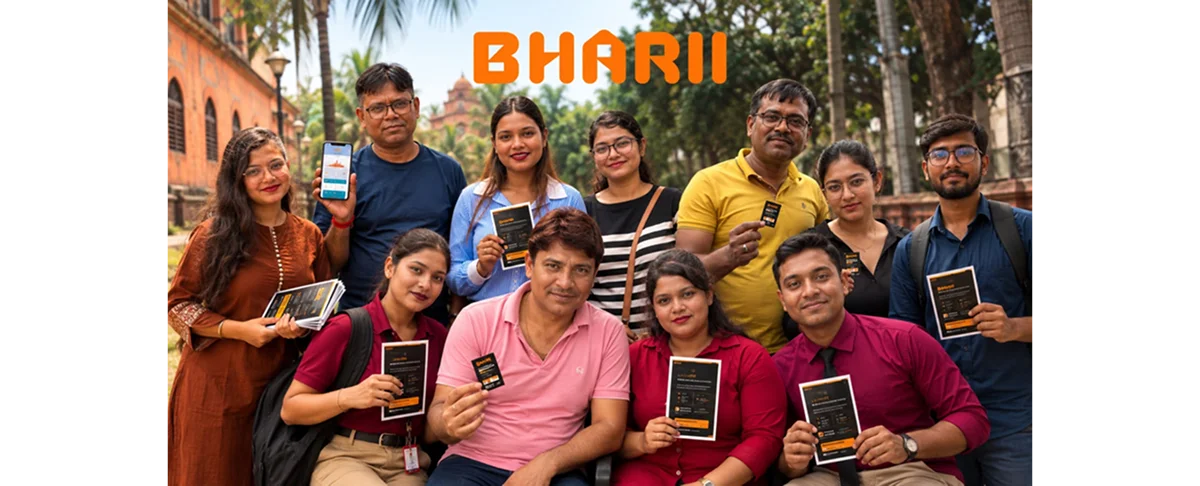
Explore BHARII
Discover BHARII and its approach to making fitness more flexible and accessible:
Website: www.bharii.com
📲 Download the BHARII App
Android: https://play.google.com/store/apps/details?id=bharii.gym